.svg)

 FREE EBOOK DOWNLOAD


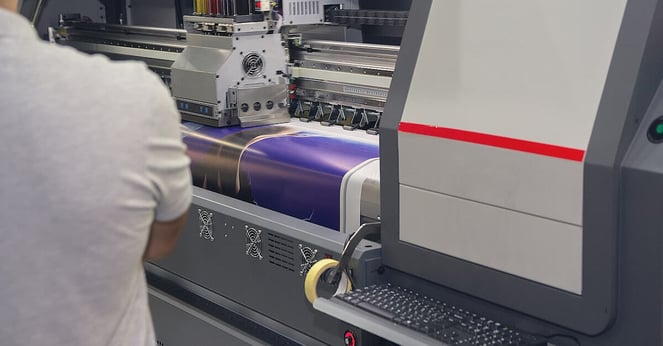
For years, high-speed inkjet technology was viewed as something reserved for large commercial print facilities.
In 2026, that distinction is disappearing.
Growing businesses are adopting modern inkjet platforms not just for print quality but for cost control, workflow automation, faster turnaround, and new revenue opportunities.
The future of print isn’t about size. It’s about scalability.
What Has Changed About Inkjet Technology?
Today’s production-class inkjet systems are:
- Faster than legacy toner systems
- More energy efficient
- Designed with fewer moving parts (reducing service interruptions)
- Capable of advanced color matching and specialty applications
- Built for automation and simplified workflows
Most importantly, they are now accessible to organizations that don’t have dedicated press operators.
Ease of use is no longer optional. It’s expected.
Is Inkjet Actually More Affordable Than Toner?
In many mid-volume environments, yes. Dealer comparisons in 2026 show:
- Traditional color toner: approximately $0.04 per page
- Modern inkjet: approximately $0.007 per page
That’s a difference of $0.033 per image.
At 500,000 images per year, that’s roughly $16,500 in annual savings. At 1,000,000 images, that climbs to $33,000 saved annually.
For a growing business, that difference isn’t incremental. It’s strategic.
Even more compelling ... Adding color can cost as little as a fraction of a cent more per page, making “color for the cost of black and white” a practical reality.
That shifts how organizations think about brand presentation, marketing materials, and customer communications.
Why Are Growing Businesses Bringing Work Back In-House?
Across the industry, companies are using modern inkjet systems to:
- Eliminate outsourcing for long-run books, marketing collateral, and packaging
- Reduce turnaround times for urgent projects
- Improve margin control
- Maintain quality consistency across print runs
With improved uptime and automation, businesses can move from reactive production to true print-on-demand environments.
In some cases, automated workflows now allow files to move from submission to finished product in minutes, reducing labor dependency and manual intervention.
For small teams, that matters.
How Does Workflow Automation Change the Equation?
Modern inkjet platforms are increasingly paired with workflow software that:
- Automates job processing
- Routes files to the correct device automatically
- Integrates finishing
- Reduces operator error
- Supports multi-shift production without adding headcount
As experienced press operators become harder to find, automation is no longer a luxury — it’s a necessity.
Growing organizations benefit from technology that simplifies production instead of complicating it.
Does Inkjet Deliver Professional-Level Color?
Yes — and in 2026, that’s one of its strongest differentiators. Today’s advanced inkjet presses offer:
- Highly accurate brand color matching
- Specialty color capabilities
- Expanded substrate options
- Long-sheet applications
- Consistent duplex performance
Research has shown that color-enhanced educational and marketing materials can significantly increase engagement; in some cases, improving attention by more than 80%.
When color becomes affordable, it becomes strategic.
Is Inkjet Only for High-Volume Print Shops?
No.
The newest generation of inkjet platforms is scalable. They are designed for:
- Growing marketing teams
- Expanding organizations
- In-plants
- Mid-volume commercial environments
- Businesses preparing for future growth
The shift isn’t about printing more. It’s about printing smarter.
The Bigger Picture: The Future of Print Is Scalable
In 2026, the most successful growing businesses are not asking: “How big is the machine?”
They’re asking:
- Does it reduce long-term costs?
- Does it automate workflows?
- Does it bring outsourced work back in-house?
- Does it support growth without adding labor?
- Does it elevate our brand?
Modern inkjet answers yes to all five.
The future of print belongs to organizations that invest in scalable technology — technology that evolves as they do.
If you’re evaluating how print fits into your growth strategy in 2026, explore scalable inkjet solutions designed to support growing businesses with SumnerOne.









.svg "SumnerOne-Logo_Main-White(RGB)")